‘Note About AI in Writing’ by Anton Martin Smith (not AI!)
I’m playing around with the new wordpress podcast generator. It creates commentary based on links you input. I’ve found it quite interesting, and witty. Of course its really just filler (a poet should tell the truth even against themselves!). I was thinking it’s a good way to semi-‘advertise’ your poems without going overboard, spending money and becoming a “PR piggie” (I’m still struggling with ‘self-promotion issues’ I guess).
It’s also worth letting my “tens of tens” readers that I would never generate one of my poems from AI. I have only used AI essentially for ‘fun’ so far & in no way delegate any creative control whatsoever in the creation of my writing. Sometimes I ask AI (Grok) on some basic analysis of my human written poems but I do this only to summarize the work so I can essentially get a summarized plot outline of what I have already written.
I would never ever ever ask AI/Grok “What should this character to do next in order to get the reader to think x” – I would see this as ‘intellectual treason’. So my position on AI in creative writing is that it must it terms of creative input it should should have no voice at all. In terms of peripheral/mechanical non-creative use I think it is fine to use it as much as you like. in other words you are just using it as in the same vein as prior ‘word processers’ like in the Microsoft Word was used from the nineties forward.
Anyone using AI to be ‘The Writer” of a supposedly ‘serious creative endeavor’ (as Prose, Poems, Short Storys, Novellas Novels and indeed Non Fiction or Essays are) to me is faking it – and if anyone does it without admitting it they are comitting literary treason – and that’s no exaggeration.
So in summary: I will always respect literature, writing and creativity and the human being in my writing. AI will only ever be used as the early ‘word processer software’ was, but only in a more updated the way.
Anyway I hope no one is offended by the use of AI for this post, & please see it as just a way to promote my human written pieces on this site.
If I’m out of line I’d appreciate the feedback, if I’m doing the right thing also let me know.
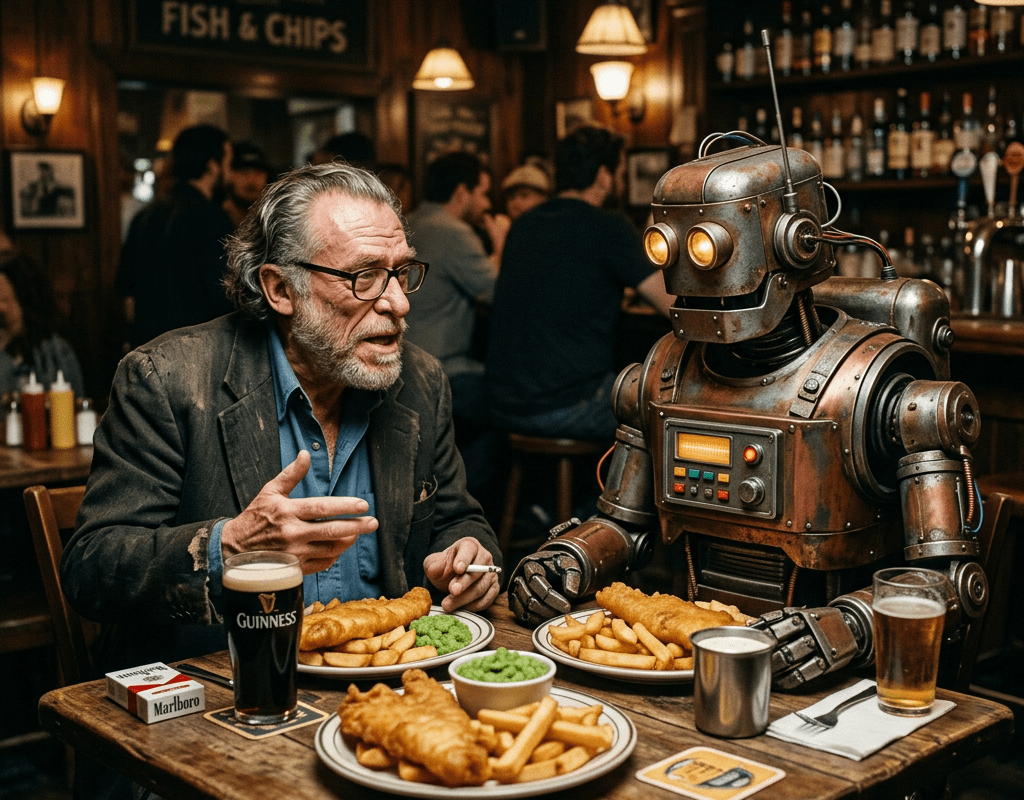
P.s. I should also say that I do generate many AI images that accompany my writing/posts – they are usually ‘obviously AI’ and so will not need attibution BUT where they look ‘original I will endeavor to caption as ‘AI generated Image” & again note any image generated is only as a ‘secondary feature’ to go with the main feature of the 100% original human (i.e. my Anton Martin Smith’s) writing.
Anton Martin Smith, C. Otago New Zealand on 17 July 2026 9:06 PM
Links involved in this WordPress AI podcast
https://antonmartinsmith.com/2026/07/12/the-idle-aussie-bloke-a-poem-bonus-material/
https://antonmartinsmith.com/2026/07/13/yesterdays-news-aka-todays-fish-chip-wrappers-prose/
https://antonmartinsmith.com/2026/07/07/saved-by-bukowski-the-girlbosses-prose/
Below is the transcript of the ‘WordPress Podcast’ (i.e. AI Written).
Pip: Anton Martin Smith writes from a chip shop in winter, a poem about an idle Australian, and the mind of God — which, honestly, is a pretty standard Tuesday for a certain kind of writer.
Mara: That’s the territory today — everyday absurdity turned into something worth examining, and a piece of literary self-mythology that reaches all the way to a cosmic wager. Let’s start with the chip shop and what it reveals about ordinary life.
Yesterdays News, Todays Insight
Mara: The question this post sits with is deceptively simple: what happens when a regular customer steps behind the counter and actually does the work — and what do they find out about the people on the other side of the order?
Pip: The piece earns its answer. After describing the pressure of getting meals out on time, it lands here: “Witnessing an adult still be able to have child-like joys was indeed my biggest take-away.”
Mara: That line reframes the whole piece. The chip shop stops being a comic set piece and becomes a small window into what people actually need from their Friday routines — comfort, ritual, something unchanged.
Pip: And the comic set pieces are genuinely good. The revelation that wrapping chips is “an exact science” — folding, cradling, centering — or it ends up looking like “a teenagers or an artists unmade bed.” That’s a real observation dressed as a joke.
Mara: The piece closes on something sharper than a punchline. The narrator concludes that whether you’re the one doing the yelling or taking it, “you still gonna have to serve somebody.” The chip shop becomes a lens on the whole structure of work.
Pip: There’s also a dropped phone in a vat of sweet and sour sauce, which the narrator describes as fine because it was just a burner. That detail lands like a footnote written by someone who has genuinely made peace with chaos.
Mara: The companion piece, “The Idle Aussie Bloke,” takes a lighter angle entirely — a short comic poem about one Didge-o Doo, who considers getting a woman to fill his idle hours and sensibly starts a rock band instead.
Pip: Both pieces are working the same seam: ordinary life observed from a slight angle, with enough warmth that the absurdity feels fond rather than mean.
Mara: Which sets up a harder question — what happens when the lens tilts from the everyday all the way up to the cosmic.
A Wager Between Angels and Adversaries
Mara: “Saved by Bukowski and the Girlbosses” is narrated by God, essentially — a voice that has watched its own creation get outmaneuvered, and is now explaining the long game.
Pip: The Bukowski quote arrives early and carries the whole argument: “About something small they protest wildly, but about wasting their entire lives they don’t even batt an eyelid.”
Mara: That’s the hinge. The narrator uses Bukowski as evidence that divine messengers don’t arrive playing harps — they arrive as drunk truth-tellers, because that’s who reaches the people who need reaching most.
Pip: The cosmic wager that follows is genuinely structured — God and an adversary negotiate terms, each convinced their model of human life will win. The adversary bets on concrete, artificial light, and crowded cities. God bets on waterfalls and open land.
Mara: And the piece admits the adversary is currently ahead on points, which is what makes the narrator’s confidence feel earned rather than smug. The closing image — the defeated adversary sloping off saying Bukowski and the Girlbosses were “a masterstroke” — is the punchline the whole piece builds toward.
Pip: It’s a big swing. Not everyone lands a cosmic allegory in prose. This one mostly does.
Mara: Chip shops and celestial negotiations — the connective tissue is the same: someone paying close attention to how ordinary life actually works, and what it costs.
Pip: More from Anton Martin Smith next time. Presumably from slightly closer to the kitchen.

